

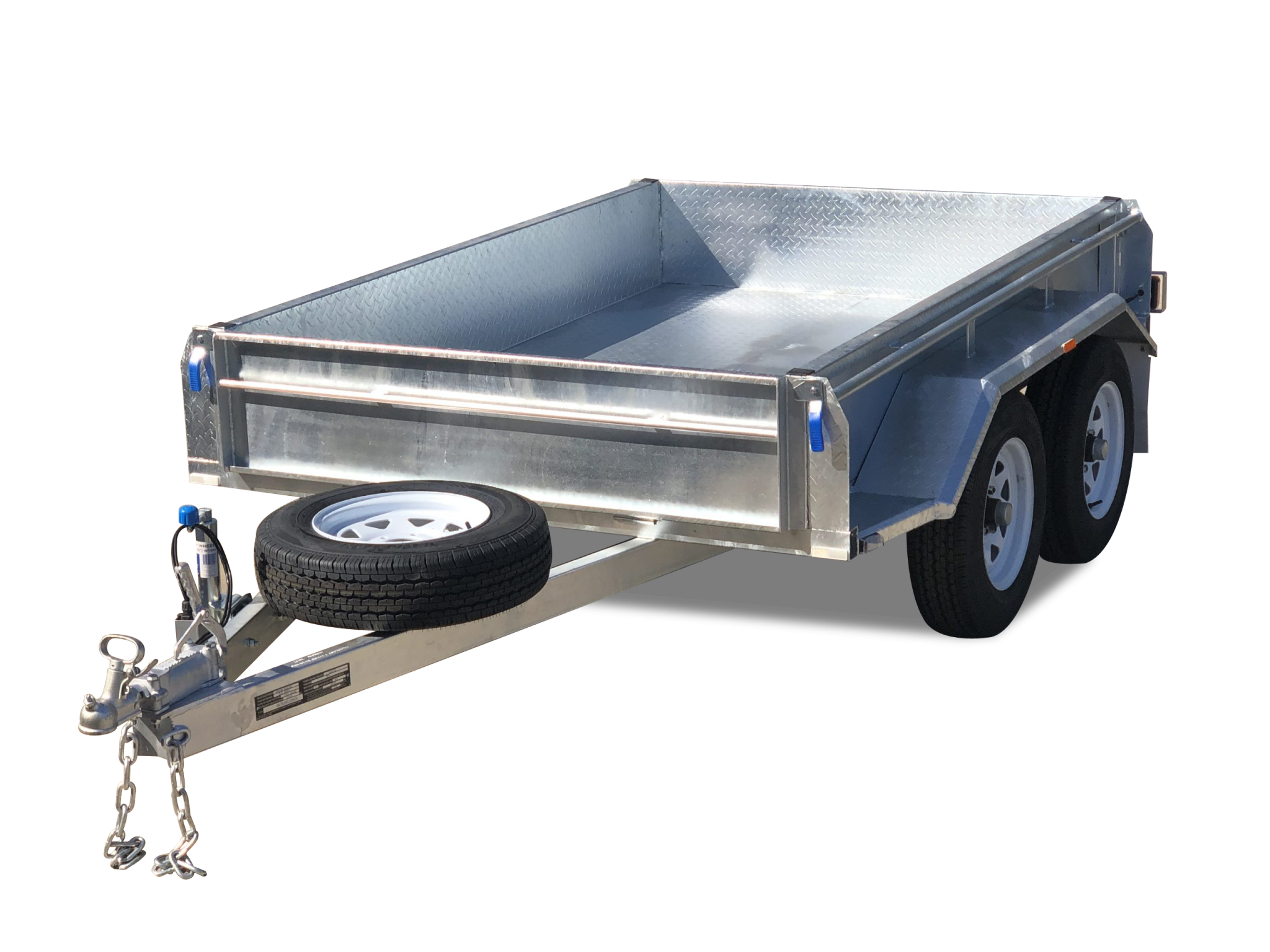
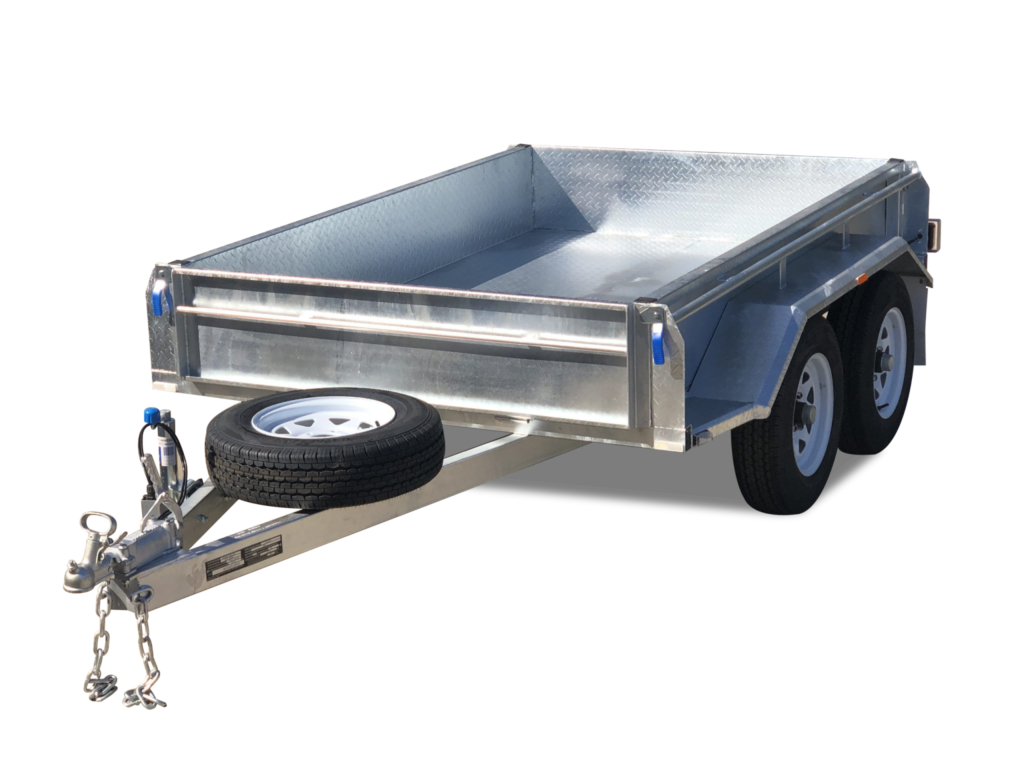
If you are towing a trailer anywhere in Western Australia, the single most important thing to know is that you are capped at 100 km/h, even on roads posted at 110. That limit comes from the Road Traffic Code 2000 and it is not signposted anywhere. It applies no matter how light the trailer is. Plenty of people who have towed for years in other states do not know this, and it is the most common way an otherwise careful driver picks up a fine on a WA highway.
The rest of the rules are less surprising but no less important. This guide covers what the law requires of you when you tow in WA, what to check before you leave, and how to load a trailer so it behaves itself at speed. It is written for people hiring a trailer rather than owning one, so it assumes you have not towed recently and are not familiar with the specific unit.
How fast can you tow in Western Australia?
100 km/h. That is the maximum, full stop.
The Road Traffic Code 2000 provides that a person must not drive a vehicle to which a trailer or other vehicle is attached at a speed exceeding 100 km/h. Main Roads Western Australia lists this among the statutory speed limits, which are the limits that apply by regulation rather than by sign. The Code expects you to know them as a condition of holding a licence.
Three consequences worth being clear about:
- It applies regardless of trailer weight. A small box trailer with a bicycle in it is subject to the same 100 km/h cap as a loaded tandem.
- It overrides the posted limit where the posted limit is higher. On a 110 zone heading north on the Brand Highway, you are still limited to 100.
- Where the posted limit is lower, the posted limit wins. The statutory limit is a ceiling, not a licence.
Your vehicle’s manufacturer may also specify a lower towing speed for that model, particularly at higher trailer weights. Where the manufacturer specifies a lower figure, that is the one to work to.
Why this catches people out. Most states set the towing speed at the posted limit, or apply a reduced limit only above a combined mass threshold. Western Australia applies a flat 100 km/h to every towing combination. If you have towed interstate and are applying that experience here, you are probably applying the wrong rule.
Does the trailer need brakes?
It depends on the gross trailer mass, and the thresholds are set out clearly in the Department of Transport’s safe towing guidance.
| Gross trailer mass | Braking requirement |
| Single axle, not over 750 kg | Brakes not required |
| Over 750 kg | Brakes required |
| Over 750 kg and not over 2,000 kg | Braking on the wheels of at least one axle. Over-ride brakes are permitted |
| Over 2,000 kg | Braking on all wheels, operated from the driver’s seated position. Over-ride brakes are not permitted |
There is a companion rule that matters just as much and is easier to miss. If a trailer is not fitted with brakes, its loaded mass must not exceed 750 kg. That is a limit on what you can put in it, not just on what the trailer weighs empty. A light unbraked trailer loaded with pavers can exceed 750 kg without looking full.
This is one reason a braked tandem trailer is a more forgiving thing to hire than an unbraked box trailer. Burswood Car Rentals hires braked tandem trailers, which removes the 750 kg loaded mass ceiling from the equation and gives you braking that works with the tow vehicle rather than relying on it entirely.
What about safety chains?
Safety chains are mandatory. Their job is to keep the trailer attached to the vehicle if the coupling releases, which is a rare event with an enormous consequence.
The Department of Transport’s Safe Towing Guide sets the requirement by aggregate trailer mass:
- Under 2,500 kg aggregate trailer mass: at least one safety chain.
- Between 2,500 kg and 3,500 kg: two safety chains.
Chains must meet the applicable Australian Standard. For trailers up to 3,500 kg aggregate trailer mass, Australian Design Rule 62/02 requires compliance with AS 4177, the standard covering caravan and light trailer towing components. Complying chain carries a marking repeated along its length, which is how an inspector tells rated chain from hardware store chain.
In practice, on a hire trailer, the chains will already be correct. What you need to get right is how you connect them. Cross the chains under the drawbar so that if the coupling lets go, the drawbar lands in the cradle the chains form rather than digging into the road. Leave enough slack to turn, but not so much that the drawbar can reach the ground.
Is the tow vehicle up to the job?
Two numbers matter and they are not the same number.
The towbar and coupling capacity must be at least equal to the loaded mass of the trailer. On a vehicle built after January 1992, the towbar must be marked with its load capacity along with either the vehicle model it was designed for or the manufacturer’s part number. If you are looking at an unmarked towbar on a modern vehicle, that is a problem.
The vehicle’s towing capacity is set by its manufacturer and is often quoted as two separate figures, one for a braked trailer and one for an unbraked trailer. The braked figure is usually much higher.
Where a vehicle was built before 1 January 1992 and the manufacturer never specified a maximum towing capacity, the fallback guidance is 1.5 times the unloaded mass of the vehicle for a trailer fitted with appropriate brakes, and a maximum of 750 kg for a trailer without brakes. This is rarely relevant to a hire vehicle but it comes up with older private tow vehicles.
The loaded mass of the trailer must never exceed the trailer’s aggregate trailer mass, which is the maximum the trailer itself is rated to weigh when loaded. If you are unsure what your combination actually weighs, a public weighbridge will tell you in a few minutes.
How do you load a trailer so it tows properly?
Trailer sway is almost always a loading problem rather than a driving problem. Get the loading right and most of the difficulty disappears.
Put weight forward of the axle
The heaviest items go slightly forward of the trailer’s axle, low down and centred. This puts a modest downward load on the towball, which is what keeps the trailer tracking behind you. A trailer loaded heavy at the back will lift the ball, unload the tow vehicle’s rear wheels and start to sway.
Balance side to side
A load stacked against one side pulls the trailer out of line and loads one tyre far more than the other. Spread it.
Restrain everything
In Western Australia, load restraint on all vehicles is governed by the Road Traffic (Vehicles) Regulations 2014, which reference the Load Restraint Guide 2004, Second Edition. This is a genuine difference from most of the country. Queensland, New South Wales, Victoria, Tasmania, South Australia and the ACT reference the 2018 light vehicle guide instead. The National Transport Commission has noted there is no material practical difference between the performance standards in the two editions, but the version with legal standing in WA is the 2004 guide.
The headline standard is that the restraint must withstand 0.8 times the mass of the load in the forward direction, which is what hard braking generates. Use rated straps and ratchet tie downs rather than rope, use a net or tarp over anything that could lift out, and check the load again after the first twenty minutes of driving.
Do not fill it just because it is empty
Volume is not the constraint. Mass is. A tandem trailer will physically hold more sand than you are allowed to carry in it.
The pre-departure check
Five minutes before you leave, every time. Most towing incidents trace back to something on this list.
- Coupling seated and locked. Latch fully engaged, locking pin or clip in place. Lift the drawbar to confirm it will not come off the ball.
- Safety chains crossed and connected to rated attachment points, with enough slack to turn and not enough to touch the road.
- Lights working. Indicators, brake lights, tail lights and number plate light. Have someone stand behind while you cycle through them. Trailer lights must operate in unison with the vehicle’s.
- Electrical plug seated and the lead routed so it cannot drag or stretch on a tight turn.
- Pressure and condition on the trailer and the tow vehicle. Trailer tyres often sit for long periods and lose pressure. Do not forget the spare.
- Jockey wheel raised and locked clear of the road.
- Load restrained and, if applicable, the tarp or net secured at every edge.
- If the trailer is wider than the tow vehicle, you need to be able to see past it. Extension mirrors may be required.
- Brake controller set if the trailer has electric brakes.
Driving with a trailer behind you
The vehicle you are driving is now considerably longer and heavier, and it responds differently to everything.
- Braking distance increases. Leave much more room than feels necessary, particularly on a wet Kwinana Freeway.
- Keep back from heavy vehicles. When towing in WA you must stay at least 60 metres behind a heavy vehicle or another towing vehicle, unless you are overtaking.
- Take corners wider. The trailer cuts inside your line. Roundabouts and kerbside turns in the older inner suburbs are where trailers meet kerbs.
- Overtake with far more room than you would normally use, and think carefully about whether you need to at all.
- Avoid sudden steering inputs. Sway is usually triggered by a quick correction. If it starts, ease off the accelerator, keep the steering straight and let it settle rather than braking hard.
- Reversing takes practice. Small steering inputs, and an observer outside the vehicle is genuinely helpful. Find an empty carpark and try it once before you need to do it in a driveway.
What are people usually hiring a trailer for in Perth?
Four jobs account for most trailer hires, and each one has a different answer to the question of what else you need.
Moving house
The most common reason and the one where a trailer changes the day most. A trailer behind an SUV or a ute turns a repeated shuttle into one or two runs. If you are moving a full household, hiring the tow vehicle and the trailer together from the same supplier means the combination is matched and approved, and you are not trying to fit a hired trailer to a car that was never set up to tow.
Tip and green waste runs
Perth’s transfer stations are built for trailers. Watch the loaded mass rather than the volume, particularly with soil, sand and wet green waste, which are all much heavier than they look.
Renovation and garden projects
Pavers, sleepers, mulch, demolition waste. This is the category where the 750 kg unbraked limit bites hardest, and where a braked tandem is worth the difference.
Taking gear away for a trip
Camping equipment, bikes, boards, fishing gear. Bulky rather than heavy, so mass is rarely the constraint. What matters here is that everything is covered and restrained, because this is the load type most likely to lift out at speed.
Practical notes for hiring a trailer in Perth
- Check your vehicle is actually set up to tow before you book the trailer. A towbar is not standard on every vehicle and an electrical connection is not always fitted even where a towbar is.
- If you are hiring the tow vehicle too, book both together. It removes the question of whether the combination is approved.
- Photograph the trailer before you leave. Chassis, tyres, lights, coupling, and the interior of the tray.
- Practise the reverse once. Five minutes in an empty carpark is worth an hour of frustration later.
- Plan your parking. A tow vehicle and trailer will not fit in a standard bay, and many Perth shopping centre carparks have height and length restrictions.
- The Burswood depot is at 16 Teddington Road, on the airport to city route, which makes collection straightforward from most directions.
Common questions
Can a learner driver tow a trailer in WA?
Under WA licensing rules, a learner may tow while accompanied by an experienced driver. This differs from several other states, where learner drivers cannot tow at all. Hire agreements set their own driver requirements though, and these are usually stricter than the licensing rules, so confirm before booking.
Do I need a special licence to tow?
For a light trailer behind a standard vehicle, no. A C class licence covers it, provided the combination stays within the rated limits of the vehicle, the towbar and the trailer.
Can anyone ride in the trailer?
No. Never, under any circumstances.
What if a light stops working on the way?
You cannot legally continue with a trailer whose lights are not operating. Most failures are the plug working loose rather than a bulb, so check the connection first.
Booking a trailer
Work out the mass of what you are moving before you choose the trailer, not after. If the load is heavy, a braked tandem is the right unit. If you also need the tow vehicle, book both on the same reservation so the combination is matched.
The Instant Quote on the Burswood Car Rentals site will show availability for trailers and tow vehicles together. If you are not sure whether your own vehicle is suitable, call (08) 9362 4777 or send a message on WhatsApp to 0438 757 909 and describe the vehicle and the load.