

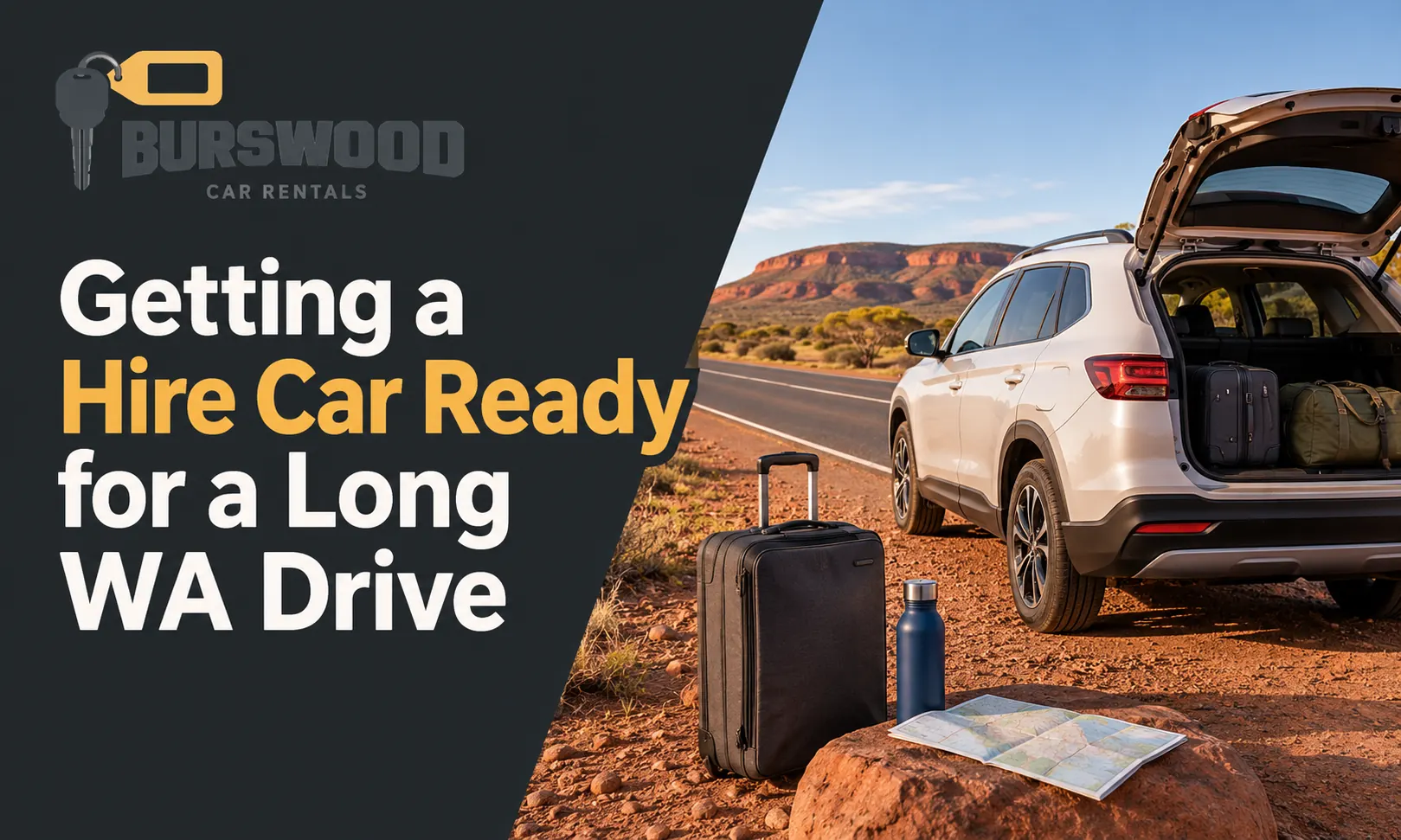
Before a long drive in Western Australia, do four things: confirm with the hire company whether your route is permitted, check the Main Roads WA Travel Map for closures, plan your fuel around where you can actually buy it rather than the vehicle’s range, and arrange the day so you are not driving at dawn, dusk or after dark in wildlife country.
Everything else on the usual checklist matters too, but those four are the ones that turn a good trip into a bad one in Western Australia specifically. This is a state where the distance between two towns can exceed the length of an entire eastern state, where mobile coverage disappears outside the main corridors, and where the nearest help can be hours away. Preparation is not fussiness here. It is the difference between an inconvenience and a genuine problem.
First: check what your hire agreement allows
Do this before you plan the route, not after.
Hire agreements commonly restrict or exclude unsealed road use, and they sometimes carry distance allowances or geographic limits. In Western Australia this bites harder than almost anywhere else, because a large number of the places people most want to see involve a gravel section at some point, often the last stretch into a national park or a beach.
The three questions to ask, in this order:
- Is unsealed road use permitted, and if so, under what conditions?
- Is there a distance allowance, and what applies beyond it?
- Are there geographic limits, such as areas or regions excluded from the agreement?
Our guide to hire car insurance in Perth explains why this matters: driving outside the agreed area or on a restricted surface is commonly an exclusion, which means your liability is no longer capped at the excess.
Check the road before you commit to it
Main Roads Western Australia publishes a Travel Map at travelmap.mainroads.wa.gov.au with live information on closures, roadworks and conditions, covering sealed and unsealed roads across the state. Main Roads specifically recommends bookmarking it on your phone before a long distance trip.
Check it when you plan and again on the morning you leave. Conditions change, particularly with weather. Flooding closes roads in the north, and a road that was open last week may not be today.
Main Roads also notes that many regional roads, although sealed, still have gravel or dirt edges. That is worth knowing before you drift a wheel off the bitumen at highway speed, which is one of the more common ways a routine trip becomes an incident.
Fuel: plan around stops, not range
The mistake visitors make is planning around what the vehicle can do. The right approach is planning around where fuel can actually be bought.
In regional and outback Western Australia, fuel stops can be a long way apart, and some have limited opening hours. A roadhouse that closes at six in the afternoon is of no use at seven, regardless of how much range you have left.
- Identify the confirmed fuel stops on your route and the gaps between them, before you leave.
- Check opening hours for anything remote. Assume nothing is 24 hours unless you have confirmed it.
- Refuel when the opportunity exists, not when you need to. In remote areas, half a tank is a good reason to fill.
- Know what fuel the vehicle takes, and check at collection. Some vehicles require premium unleaded, and the wrong fuel is commonly excluded from damage cover.
- Carry a payment backup. Card facilities at remote stops can fail, and some are cash or card only.
Daylight, fatigue and wildlife
These three are connected, which is why they belong together.
Wildlife and stock
Main Roads warns that wildlife and straying stock are commonly encountered on and beside regional Western Australian roads. The risk concentrates around dawn, dusk and after dark.
The advice that matters most: do not swerve. Braking in a straight line generally produces a far better outcome than swerving at highway speed, which is how single vehicle rollovers happen. Hitting an animal is bad. Leaving the road at a hundred kilometres an hour is worse.
Fatigue
Main Roads describes fatigue as a major hazard on long distance drives in WA, and the advice is as simple as it sounds: do not drive tired. The specific trap on a WA trip is that the distances encourage pushing on, because the next town is a long way and stopping feels like losing ground.
Plan shorter driving days than you think you need, share the driving if you have a second nominated driver, and stop properly rather than pressing through. If you are collecting the vehicle straight off a long flight, consider whether starting the drive tomorrow is the better plan. Our guide to collecting a hire car when you arrive in Perth covers the delivery option for exactly this reason.
Road trains
Common across regional WA and much longer than they look from behind. Overtaking one needs a great deal of clear road and a realistic assessment of your vehicle’s acceleration while loaded. If in doubt, wait. There will be another opportunity and you are not on a schedule worth the risk.
The vehicle check before you leave Perth
The hire company is responsible for the vehicle’s maintenance and roadworthiness. That does not remove the value of ten minutes checking the things that matter on a long trip, because a problem found in Burswood is an inconvenience and the same problem found near Mount Magnet is not.
- Tyres, including the spare. Pressure and condition on all five. Confirm there is a spare at all, and that the tools to change it are present and complete.
- Do you know how to change it? Locate the jack and the wheel brace and work out how they come out before you need them in the dark.
- Fluid levels and the windscreen. A chipped windscreen will spread on a long drive.
- Lights and wipers.
- Air conditioning, which in summer in WA is a safety item rather than a comfort one.
- The fuel type, confirmed at collection.
- Photograph the vehicle thoroughly, all four corners, wheels, windscreen, roof line and interior. Stone chips are common on regional highways and you want a record of what was there before you left.
What to carry
- Water, more than you think. This is the one item that genuinely matters if you are stopped somewhere remote.
- Offline maps. Mobile coverage is limited outside the main corridors, and navigation that needs a signal is navigation that will fail you exactly where you need it.
- A charged phone and a car charger.
- Food that keeps, particularly if your route has long gaps between towns.
- Sun protection. Hat, sunscreen, sunglasses.
- A torch.
- Your hire agreement and the hire company’s contact number, saved somewhere you can reach without a signal.
- Warm layers for the south, where overnight temperatures drop more than visitors expect.
Tell someone your route. Where you are going, which road, and when you expect to arrive. On a remote WA drive this costs nothing and is the single most useful thing you can do. If something goes wrong where there is no coverage, it determines how long it takes for anyone to realise.
WA road rules worth knowing before a long drive
Several differ from the eastern states, and the ones below catch out confident drivers rather than nervous ones. Our guide to WA road rules for hire car drivers covers these in more detail.
- Towing is capped at 100 km/h. The Road Traffic Code 2000 sets a statutory limit of 100 km/h for any vehicle towing a trailer, regardless of trailer weight and regardless of the posted limit. It is not signposted. If you are taking a trailer, this applies the whole way.
- Keep 60 metres back from heavy vehicles when towing, unless overtaking.
- Load restraint in WA references the Load Restraint Guide 2004, not the 2018 light vehicle guide used in most other states. If you are carrying gear, the performance standards you need to meet are the 2004 ones.
- Provisional drivers face a midnight to 5am restriction in their first six months, with narrow exemptions. Relevant if a younger driver is sharing a long drive.
- Drive to the conditions, which on a gravel edged regional road means well below the posted limit.
Matching the vehicle to the drive
A long WA drive asks different things of a vehicle than a week around Perth does, and the choice is worth a little thought before you book.
Comfort over distance
Seat quality and cabin noise matter more than anything else on a six hour day, and they matter more than they do on any drive you will do in the metropolitan area. This is the main argument for stepping up a category for a touring trip when you would not bother for a city hire.
Driver assistance
Cruise control is close to essential on long straight highways. Adaptive cruise and lane keeping, where available, genuinely reduce fatigue over a full day. These are fatigue management tools rather than conveniences on a trip of this kind.
Luggage, honestly counted
A boot that is adequate for a weekend is often not adequate for two weeks of touring with camping gear or sporting equipment. Count the bags before you book rather than after. Where the gear is bulky rather than heavy, adding a trailer is usually easier than moving up two vehicle categories, though remember the 100 km/h towing cap applies the whole way.
Fuel consumption
Over a few thousand kilometres, consumption stops being a detail. A larger vehicle costs more to run across the whole trip, and in remote areas it also shortens your range between stops, which is the more important consequence.
Group size
If several of you are travelling, one vehicle is usually better than two on a long drive. Nobody gets separated, route decisions get made once, and the driving can be shared if everyone is nominated on the agreement. Sharing the driving is one of the most effective fatigue controls available, and it only works if the second driver is listed.
Planning the days
Three habits make a long WA trip go better, and none of them involve the vehicle.
Plan shorter days than the map suggests. The distances tempt you into eight hour driving days, and eight hours of highway concentration is more tiring than the same time doing anything else. Arrive with daylight left.
Build in a buffer. Road closures, weather and a slower pace than planned are all normal. A schedule with no slack turns every delay into a reason to drive tired.
Decide where you are stopping each night before you start. Accommodation in regional WA is limited and fills, and the fallback plan of driving a bit further is exactly the decision you do not want to be making at dusk.
Common questions
Can I take a hire car on gravel?
Only if the agreement permits it. Many restrict or exclude unsealed road use, and this is among the most common causes of a dispute after a hire in WA. Ask before you plan the route.
Do I need a 4WD?
For the sealed highways and the main southern and coastal touring routes, generally no. For remote tracks and some national park access, it changes. Check the Main Roads Travel Map and the specific access requirements for where you are going.
What if I break down somewhere remote?
Stay with the vehicle. It is easier to find and provides shade. Make sure you know what roadside assistance arrangement applies to your hire and what number to call before you leave, and have it saved offline.
Is there a speed limit difference in WA?
For an ordinary vehicle, the posted limit applies. The one to remember is the statutory 100 km/h cap when towing, which applies even where the posted limit is higher.
How far ahead should I book the vehicle?
For a long trip, early. Larger vehicles and people movers are the tightest category in any fleet and are gone first in peak periods.
Before you go
Confirm the route is permitted under your agreement. Check the Travel Map. Plan fuel around confirmed open stops. Keep the driving in daylight. Tell someone where you are going. Everything else is detail.
Burswood Car Rentals hires from compact cars through to SUVs, people movers, utes and trailers from its depot at 16 Teddington Road, Burswood. To check what suits a long regional drive and what the agreement allows on your route, call (08) 9362 4777 or message on WhatsApp on 0438 757 909. The Instant Quote will show availability for your dates, and you can see the full fleet before you choose.